NJ Bio and Aruka Bio Announce the Development of ARK-101, a Next-Generation HER2 ADC Designed to Reduce ILD Risk for Potential Treatment of Breast Cancer
NJ Bio and Aruka Bio Announce the Development of ARK-101, a Next-Generation HER2 ADC Designed to Reduce ILD Risk for Potential Treatment of Breast Cancer
Potential best-in-class HER2 ADC engineered to maintain T-Dxd efficacy while addressing ILD risk
Addresses one of the most significant safety challenges in HER2 ADC therapy, with potential to improve treatment continuity for patients and remove the need for close lung damage monitoring
Novel translational model enables rational design and screening of safer deruxtecan-based ADCs
PRINCETON, N.J., Nov. 24, 2026 (GLOBE NEWSWIRE) -- NJ Bio, Inc. and Aruka Bio announced the development of ARK-101, a next-generation HER2-targeted antibody-drug conjugate (ADC) designed to maintain the potent antitumor activity of trastuzumab deruxtecan (T-Dxd; Enhertu) while reducing the risk of interstitial lung disease (ILD), a key dose limiting toxicity and one of the most significant safety challenges associated with current deruxtecan-based ADC therapies.
The ARK-101 program was enabled by a recently published study in Nature’s Precision Oncology journal describing a novel translational murine model that reproduces key clinical and histopathological features of ADC-induced ILD. The publication titled, Development of a Translational Murine Model for Antibody-Drug Conjugate-Induced Interstitial Lung Disease, demonstrates how the murine model identified key linker-payload components associated with ILD and enabled the rational design of novel linker-payloads to minimize ILD toxicity. This ILD model provides a valuable preclinical tool for advancing development of next-generation ADCs.
“Interstitial lung disease remains one of the greatest barriers to realizing the full potential of HER2-targeted ADC therapies,” said Naresh Jain, Ph.D., Founder and Chief Executive Officer of Aruka Bio and co-author of the study. “ARK-101 represents our continued commitment to developing next-generation ADCs that aim to balance efficacy and safety.”
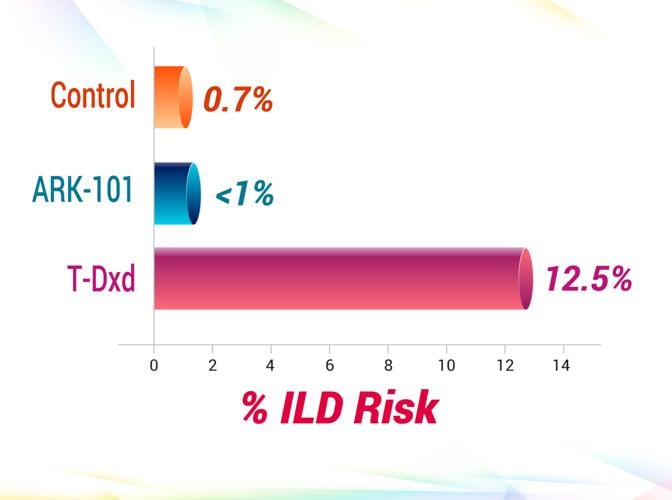
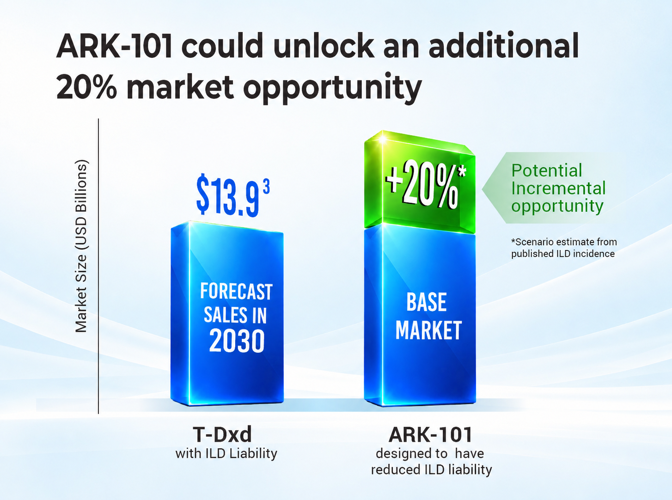
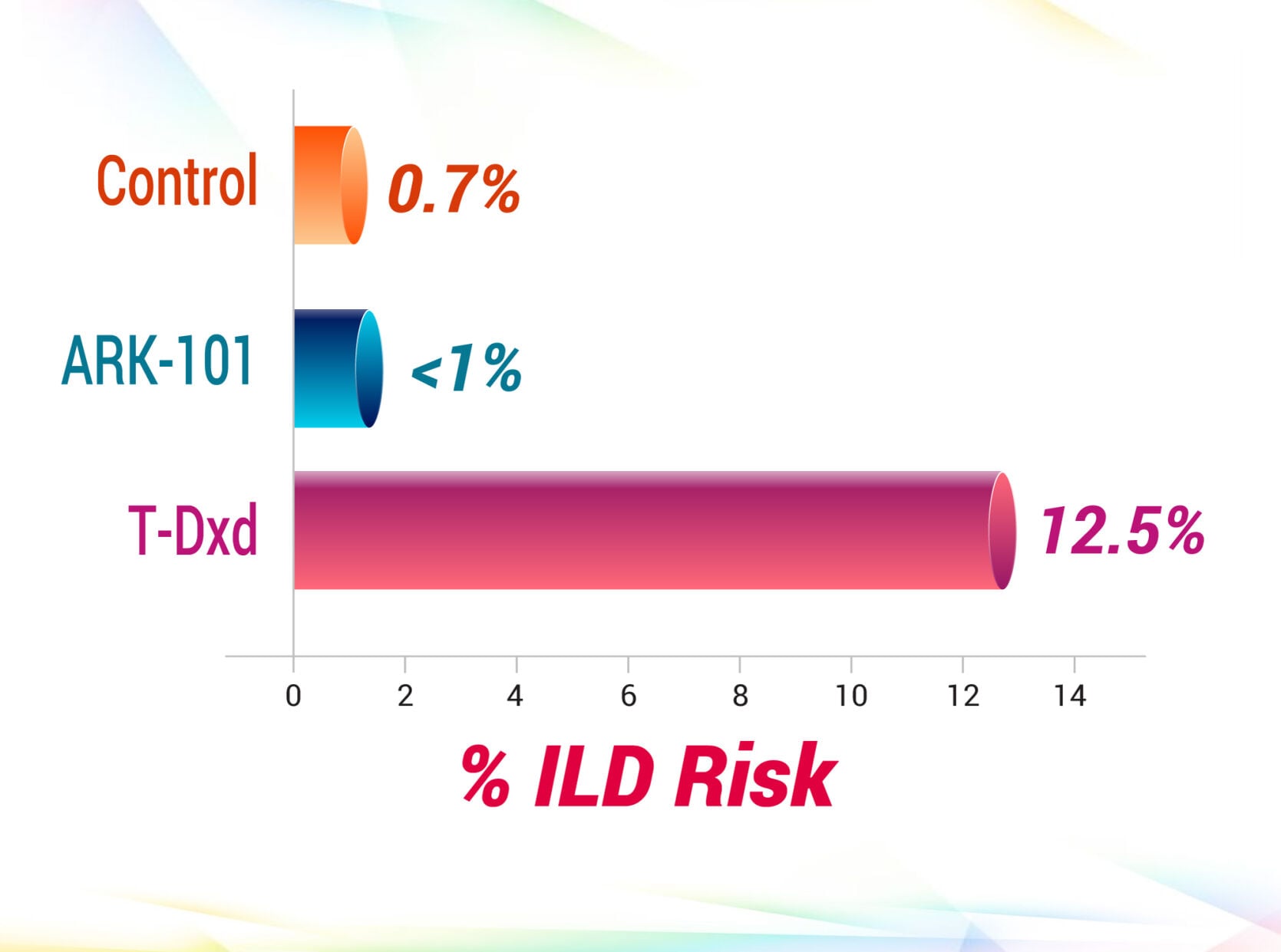
Across clinical studies and real-world experience, ILD has been reported in approximately 12.5% of patients treated with T-Dxd (Enhertu), often resulting in dose interruption, treatment modification, or permanent discontinuation. Improving the safety profile of HER2-directed deruxtecan ADCs could enable longer treatment duration, expand access for patients currently considered at elevated pulmonary risk, and reduce the burden of toxicity management on healthcare systems. By addressing one of the most important limitations of today's leading HER2 ADC therapies, ARK-101 has the potential to not only improve outcomes for existing T-Dxd-eligible patients but also those who are unable to receive T-Dxd because of ILD concerns. This combination of a large treatable patient pool, a validated target, and a differentiated safety strategy positions ARK-101 as a potentially important next-generation entrant in the ADC landscape.
“Integrating translational safety models into ADC discovery enables smarter design decisions earlier in development,” said Julien Dugal-Tessier, Ph.D., Chief Scientific Officer of NJ Bio and co-author of the publication. “We thank Aruka Bio for partnering with us to incorporate predictive safety models into the discovery process. ARK-101 demonstrates how these preclinical tools that address a clinical challenge can guide the selection of improved linker-payloads of ADCs that can deliver both exceptional efficacy and a better safety profile.”
The availability of predictive ILD models may help shift safety assessment earlier in the drug development process, allowing researchers to design ADCs with improved pulmonary safety profiles rather than relying solely on extensive patient screening and monitoring to manage risk. Aruka Bio and NJ Bio, Inc., are actively exploring strategic partnerships to accelerate global development and commercialization of ARK-101.
Intellectual Property
The linker-payload technologies evaluated in the published study are the subject of patent applications, including U.S. Patent Application Publication No. US20260315612A1 and International Publication No. WO2025222127A2.
Publication Information
The full article is available in npj Precision Oncology:
Anaganti S, Bhujade A, Murkli S, et al. Development of a Translational Murine Model for Antibody-Drug Conjugate-Induced Interstitial Lung Disease. npj Precision Oncology (2026). https://doi.org/10.1038/s41698-026-01465-3
2. Li R, Hua M, Li J, Chen W, Xu L, Meng H, Zhang Z, Liu Q, Cui Y, Xiang Q. The safety of trastuzumab deruxtecan (DS-8201) with a focus on interstitial lung disease and/or pneumonitis: A systematic review and single-arm meta-analysis. Cancer. 2024 Sep 1;130(17):2968-2977. doi: 10.1002/cncr.35349. Epub 2024 May 4. PMID: 38703012.
NJ Bio, Inc. is a drug discovery and development partner specializing in medicinal chemistry, bioconjugation, antibody-drug conjugates (ADCs), translational research and integrated CRO/CDMO services. Headquartered in Princeton, New Jersey, NJ Bio provides end-to-end solutions spanning discovery, development, and manufacturing for biotechnology and pharmaceutical companies worldwide. www.njbio.com
About Aruka Bio
Aruka Bio, Inc. is a drug development company focused on advancing biobetter antibody-drug conjugates (ADCs) designed to improve the therapeutic balance between efficacy and safety. www.arukabio.com