- New El Nino data, covering 20 cities and 3 African regions, predicts severe drought across parts of Southern Africa and stronger rainfall in East Africa, including the Sahara Desert
- WaterAid working with Governments, including Nigeria, Mozambique, and Madagascar, to prepare as Super El Nino throws continent’s normal weather patterns into chaos
- Research comes ahead of climate COP31 in Türkiye, where leaders must prioritise water security and climate finance
OTTAWA, Ontario, Nov. 05, 2026 (GLOBE NEWSWIRE) -- Drawing on more than four decades of rainfall data and past El Niño events between 1982 and 2025 across East, West and Southern Africa, the study reveals how an anticipated Super El Niño, compounded by climate change, could deepen existing climate vulnerabilities and push already extreme weather even further.
The findings point to mounting pressure on water security, urban resilience and economic stability, as millions of people face the threat of increasingly unpredictable and extreme weather as the current 2026-27 Super El Niño event heads towards record strength.
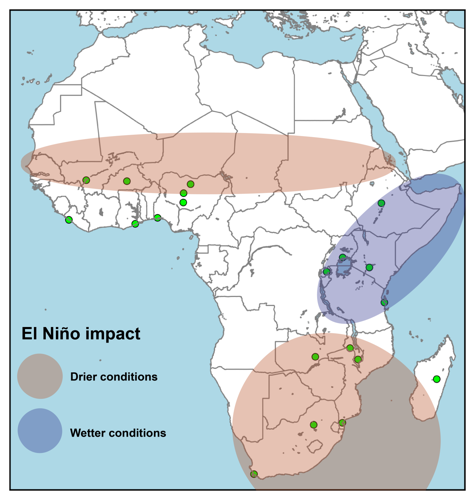
New data released this week suggests under very strong El Niños, East Africa – particularly Kenya, Somalia and Tanzania – is likely to become markedly wetter during the Super El Niño. Meanwhile, unlike the typical regional pattern, parts of Ethiopia tend to get drier during stronger El Niños, revealing a clear East-West divide in East Africa.
The majority of Southern Africa, including South Africa, Botswana, Zimbabwe and southern Mozambique is expected to face heightened risks of extreme drought. Cape Town and Antananarivo in Madagascar in contrast show above-normal rainfall during strong El Niños, contradicting the typical regional pattern.
The study also finds that the drying risk in West Africa falls mainly on coastal cities, whereas surprisingly parts of the dry Sahel region could become wetter than normal during El Niño.
Heavy rainfall increases the risk of flash flooding, damage to water and sanitation infrastructure, contamination of drinking water and outbreaks of waterborne diseases such as cholera. Meanwhile, drought and reduced rainfall threaten reservoirs, municipal water supplies and agricultural production, potentially placing communities under pressure well into 2027.
These impacts are likely to fall hardest on people already most vulnerable to climate change, despite having contributed the least to global greenhouse gas emissions.
WaterAid Canada’s CEO, Justin Murgai, said, “We cannot afford to prepare for tomorrow’s climate emergencies using yesterday’s assumptions.”
“This research is a wake-up call. When we misjudge where droughts and floods will hit, communities pay the price. As world leaders gather at COP31, Canada has an opportunity to push for climate financing that responds to the evidence and invests in what protects lives: reliable water and sanitation."
The findings: Super El Niño threatens a dramatic continental divide between floods and drought
The analysis examines the impacts of El Niño events between 1982 and 2025 across cities in East, West and Southern Africa, revealing how an anticipated Super El Niño could exacerbate existing climate vulnerabilities across the continent.
1. Southern Africa: The strongest drought signal on the continent, yet Cape Town and Antananarivo go against the regional trend.
Southern Africa showed the most consistent climate response to El Niño, with cities including Maputo (Mozambique), Blantyre (Malawi), Lusaka (Zambia) and Johannesburg (South Africa) becoming progressively drier as El Niño intensifies.
The analysis aligns with forecasts suggesting a 70% chance that rainfall deficits in parts of southern Malawi, Mozambique, Zambia and Zimbabwe will exceed those recorded during any El Niño event since 1950.
While most of Southern Africa dries, Cape Town – which came close to running out of water in 2018 – and Antananarivo in Madagascar show no drying signal. If anything, both lean slightly wetter during strong El Niños. This contradicts the published impact maps (e.g. from WMO).
2. Not all of East Africa gets wetter: regions faces divided climate impacts.
The strongest wetting signals were found in Nairobi (Kenya) and Dar es Salaam (Tanzania), with both cities becoming significantly wetter during strong El Niño events. The analysis also found wetter conditions in Kampala (Uganda).
Unlike the typical regional pattern, Addis Ababa tends to get drier during stronger El Niños. It had one of its driest periods on record during the 2015/16 event.
The findings come as regional forecasters indicate a 90% chance of above-normal rainfall across parts of Kenya, Somalia and southern Ethiopia during the October–December short rainy season, increasing concerns about flooding and damage to essential infrastructure.
3. West Africa’s drying occurs on the coast, not the Sahel.
Widely used El Niño impact maps, such as those issued by the WMO, place the main drying risk across the Sahel. This new regional analysis instead puts the strongest drying in the coastal belt from Liberia to Nigeria, home to major cities such as Lagos and Monrovia. Some parts of the Sahel even become wetter than normal during El Niño.
The clearest drying signals were observed in coastal cities Lagos (Nigeria) and Monrovia (Liberia), both of which have experienced drier-than-normal conditions during previous strong El Niño events.
Parts of the region are already facing low streamflow and reduced water availability following a below-normal 2026 rainy season, raising concerns about future water security.
In contrast, cities across the Sahelian savannah region, south of the Sahara Desert, including Bamako (Mali) and Ouagadougou (Burkina Faso), have become wetter and more flood-prone during strong El Niño events.
Cities are already taking action
“El Niño does not have to become a water and sanitation emergency,” says Patience Mukuyu, WaterAid’s Senior Policy Analyst on Water Security.
“African countries have learnt from previous El Niño events that investing in water and sanitation services designed to withstand extreme weather events and climate shocks protects lives, livelihoods and communities, both now and in the future.”Across Africa, WaterAid is working with local governments and city leaders to prepare for anticipated Super El Niño extremes and strengthen long-term water and climate resilience.
In Lagos, Nigeria, WaterAid is working to climate-proof water and sanitation infrastructure by raising latrines above known flood levels, burying water pipes deeper underground to protect them from erosion and damage when floodwaters wash away topsoil, and designing sewage pits to prevent flooding and contamination of drinking water.
In Maputo, Mozambique, WaterAid’s country director Gaspar Sitefane says, “We should not wait for drought or water stress to materialise before we start acting. Our approach should be anticipatory: identify the risks, define the triggers that should prompt action and prepare in advance the interventions that can be activated if the anticipated conditions materialise.”
In Madagascar, preparations are already underway for Super El Niño, including groundwater monitoring to spot water shortages early, pre-positioning WASH supplies, and expanding water storage in high-risk communities. According to WaterAid Head of Programmes in Madagascar, Hanta Rabesandratana, “While the El Niño impacts on the capital city may prove limited, we are working in the Deep South of the country which seems highly likely to be inflicted by yet more serious drought conditions.”
Tanzania in East Africa is facing the prospect of increased flooding, a climate impact they have endured on many occasions in recent years. WaterAid has been working in Hanang in the north of the country, to rebuild and protect water systems which were destroyed by floods three years ago, to ensure they can withstand the extreme weather expected in coming months.
Urgent action needed at COP31
Globally, 90% of climate-related disasters are caused by too much or too little water.
While global commitments on water security and climate adaptation have been agreed at previous COPs, WaterAid warns that for millions of people on the frontlines of the climate crisis, these commitments are still not translating into action at the scale required.
At COP31, WaterAid is calling for urgent political action and cross-sectoral investment so that communities on the frontlines of the climate crisis have reliable access to water, sanitation and hygiene services they need to build resilience and adapt to a changing climate – protecting lives, rights and livelihoods.
Adnan Qader, Manager, Water Governance and Resilience, WaterAid Canada, added, “Our analysis of 44 years of rainfall data shows that El Niño does not affect African cities uniformly: stronger events increase flood risk in parts of East Africa, drought risk across much of Southern Africa, and drying risk in coastal West African cities. Canada is part of this global picture too: El Niño years are generally associated with lower river flows on the Prairies. Investing in WASH is a very important element missing from conversations. WASH is one part of adaptation, but a vital one—safe water, sanitation and hygiene protect health when floods contaminate supplies or drought reduces water availability.”
According to the report’s lead researcher, Katerina Michaelides, Professor of Dryland Hydrology at the University of Bristol, “Our analysis shows how regional differences in rainfall impacts get amplified across Africa as El Niño events strengthen.”
“This year’s El Niño is already off the charts and is expected to be the largest ever recorded. Cities in East Africa need to prepare for flooding and cities in Southern Africa for water shortages. Coastal West African cities also face a drying risk that standard impact maps don't show. Past events are a guide, not a ceiling. The 2026–27 El Niño is forecast to be stronger than any event in the 44-year record. Its impacts may be larger than, or different from, those seen before. The findings show the likely direction and location of impacts and should be used alongside the latest national and regional seasonal forecasts.”
Photos accompanying this announcement are available at:
NEWS RELEASE TRANSMITTED BY Globe Newswire