BOSTON, Nov. 16, 2026 (GLOBE NEWSWIRE) -- A new analysis of the 2800-person, 20-year Advanced Cognitive Training for Independent and Vital Elderly (ACTIVE) Study, being presented at the international Clinical Trials in Alzheimer’s Disease (CTAD) conference in Boston, explains the mechanism by which a speed-of-processing brain exercise reduced the incidence of Alzheimer’s Disease and Related Dementias (ADRD), validates a surprising modifiable risk factor for ADRD, and fuels the promise of a new class of digital therapeutics often referred to as “software as medicine.” The brain exercise used in the ACTIVE Study is available only through the brain exercise platform BrainHQ made by Posit Science.
“Many experts were caught by surprise when the ACTIVE Study results grabbed headlines around the globe in February by showing a small amount of speed training — less than 24 hours spread over the first three years — reduced ADRD diagnoses significantly and substantially over the 20-year study,” observed Dr. Henry Mahncke, a leading researcher in brain plasticity and CEO of Posit Science. “We wanted to dig into the data to understand why so little speed training worked so well.”
“It’s well known that specific risk factors – such as lack of exercise and poor diet – put people at risk, and that changing behaviors can lower risk for type II diabetes and heart attacks,” Mahncke added. “We know that, because researchers applied scientific method to identify modifiable risk factors for those diseases. This new analysis applied that proven framework to ADRD prevention.”
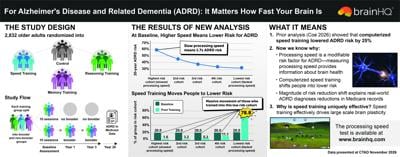
First, researchers looked at the relationship between cognitive function at the start of the study, and long-term ADRD incidence in Medicare records. They found all three cognitive functions trained by different arms of the study – processing speed, reasoning, and memory – were predictive of ADRD.
“That’s an important finding,” Mahncke observed. “For example, people in the slowest processing speed quintile were about 1.7 times more likely to go on to ADRD over the next twenty years compared to the fastest processing speed quintile.”
Next, researchers showed training significantly improved the risk profile of the speed training group. After a small amount of training, less than two percent of people remained in the highest risk quintile – and more than three-quarters were now in the fastest, safest quintile.
“That means not only is processing speed a risk factor – it’s a modifiable risk factor – and people can change their risk status,” Mahncke added. “That’s an enormous finding for ADRD.”
Finally, the researchers showed you can shift people from the highest risk quintile (due to their slow processing speed) to the lowest risk quintile through training, which explained virtually all the ADRD risk reduction observed by ACTIVE.
While reasoning and memory scores also were predictive of ADRD risk, improvements in those scores did not translate to lower ADRD diagnoses. Speed training resulted in larger boosts in cognitive function than either memory or reasoning training and gains from speed training uniquely translated to reductions in ADRD.
Mahncke noted the new analysis aligns with the science of lifelong brain plasticity, discovered in the 1970s by Dr. Michael Merzenich, who went on to harness lifelong plasticity in his co-invention of the cochlear implant (restoring hearing to people with deafness) and then to his invention of software as medicine (epitomized in the training software BrainHQ, developed under his supervision).
“Plasticity science shows the brain rewires when many neurons fire simultaneously, under conditions where the brain is adaptively challenged,” Mahncke noted. “This speed training delivers those conditions in spades. We know brain plasticity improves brain health and resilience – by building new neural connections, laying down thicker neuronal insulation, releasing growth factors, and upregulating neurochemical production. By making the brain faster, you’re also making the brain healthier, more resilient, and better able to resist ADRD.”
“This exercise was developed as a ‘digital therapeutic’ long before anyone had uttered that phrase,” Dr. Mahncke continued. “This new analysis underscores how digital therapeutics can do things that drugs and surgeons cannot yet achieve. After decades of disappointment, it offers a new path for progress.”
“A lot of experts give advice that you should remain mentally active,” Mahncke continued. “Here, the memory training and the reasoning training groups were mentally active yet had results that were not significantly different than the control group. Experts should start giving more helpful advice. My advice is to engage in activities shown effective in randomized controlled trials. So far, this is the only intervention shown in a large randomized controlled trial to lower the incidence of ADRD. Why? As plasticity science suggests, it’s because a faster brain is a better and healthier brain!”
BrainHQ has shown benefits in more than 300 studies. Such benefits include gains in cognition (attention, speed, memory, decision-making), in quality of life (depressive symptoms, confidence and control, health-related quality of life), and in real-world activities (health outcomes, balance, driving, workplace activities). BrainHQ also has been shown to improve the health of the brain as an organ, including faster neural processing, increased hippocampal activation, neuromodulator upregulation, improvements in white matter integrity, enhanced functional connectivity, and protective maintenance of the default mode network. BrainHQ is used by leading health plans, leading medical centers, clinics, and communities, and by elite athletes, the military, and other organizations focused on peak performance. Consumers can try a BrainHQ exercise for free daily at brainhq.com.